
Why Professional Security System Training Matters
The Growing Demand for Skilled Surveillance Technicians
Surveillance systems often sit in unqualified hands. A poorly positioned camera catches nothing but shadow. A misconfigured recorder loses footage at the exact moment it matters. This is the quiet failure property owners notice when it is too late.
The growing demand for skilled surveillance technicians is clear. Businesses and homeowners seek installers who understand network architecture, camera angles, and data retention. They want proof of competence, not promises. That proof begins with proper training, often found through cctv installation training courses near me.
- Formal instruction covers wiring, IP configuration, and fault diagnosis.
- Hands-on practice builds speed and accuracy on real equipment.
- Certification signals credibility to clients and employers.
Searching for cctv installation training courses near me leads to programmes that address these gaps. Good ones train you for real conditions, from load shedding to signal interference. Skilled technicians command higher rates and consistent work. Training separates guessing from knowing.
How Proper Training Reduces Costly Installation Errors
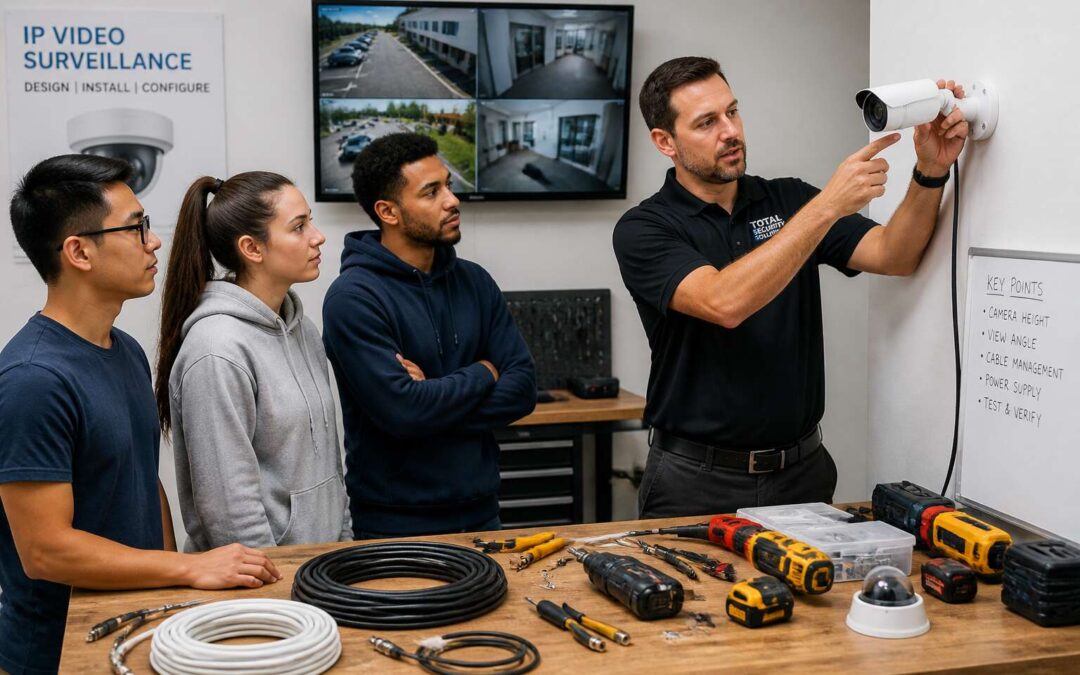
A camera mounted thirty centimetres too high misses the face of every person who walks past. That mistake is not a design flaw. It is an installation error. Training teaches you to calculate field of view, check lighting, and verify cabling before fixing a bracket. Rework costs more than training.
Consider a novice terminating a cable poorly. The signal degrades. The recorder drops frames. The client discovers it after a break-in. Proper training reduces these errors by drilling procedures until they become automatic. A structured programme, found through cctv installation training courses near me, forces you to practise on real equipment.
- Terminating RJ45 connectors
- Setting IP addresses
- Testing voltage at each camera
That discipline separates a technician from a handyman with a drill. When comparing cctv installation training courses near me, hands-on fault finding makes the difference. I have seen too many rework invoices to ignore the pattern!
Understanding Industry Standards and Safety Protocols
PSIRA registration alone does not make a technician competent. Industry standards in South Africa require working knowledge of SANS 10139 and the Occupational Health and Safety Act. These documents govern camera placement, cable management, and electrical safety. Informal training rarely covers them.
Formal cctv installation training courses near me teach you to apply these standards on site. You learn cable fastening intervals, height work permits, and electrical isolation procedures. This knowledge protects both the worker and the client.
- Ladder and scissor lift safety procedures
- Correct handling of network and electrical cabling
- PSIRA reporting requirements for installation work
Skipping these details creates liability. I have seen technicians lose contracts because they could not quote the correct standard to a client. Insurers and courts ask for proof of competence, and that proof is rarely a verbal promise!
The Value of Hands-On Practice Versus Online Theory
People retain about 90 percent of what they perform, yet only 10 percent of what they read. That disparity explains why cctv installation training courses near me must include hands-on practice!
Professional security system training matters because installation is a tactile craft. I have watched students freeze on their first crimp. A camera’s view shifts with a quarter turn of its mount. Cable jackets tear when pulled at the wrong angle. These realities surface only in the hands.
Online theory teaches the schematic. It cannot convey the weight of a drill or the resistance of a wall stud. Hands-on modules in cctv installation training courses near me build diagnostic intuition that video cannot replicate.
Consider what you learn by touch:
- Terminating RJ45 connectors without nicking the pairs
- Setting back box depths for flush mounting
- Adjusting varifocal lenses against live glare
That fluency is the difference between competence and liability.
Core Skills Covered in Camera Installation Programs
Reading Blueprints and Planning Camera Placements
Reading blueprints transforms a chaotic site into a deliberate map of observation. Reputable cctv installation training courses near me teach students to decode symbols, scale measurements, and electrical pathways before touching a single cable. This skill prevents wasted effort when planning camera placements.
Coursework drills the logic of field of view, ensuring no corner is ignored.
- Main entry and exit points
- Loading docks or delivery areas
- Cash handling rooms and server closets
These locations demand priority coverage.
Trainees also study how sunlight shifts across a room, which affects lens selection. By the end of the module, a student can walk through a floor plan and visualise coverage with confidence.
Wiring, Networking, and Power Management Basics
Wiring is where DIY camera installations go sideways! One reversed polarity can fry a camera before it captures a single frame. I have pulled enough botched jobs out of ceilings to appreciate structured training covering cable gauges, termination, and the gentle skill of feeding cable through a drop ceiling without wrecking it.
Networking adds another layer. IP addressing, bandwidth limits, and switch configuration decide whether video streams actually arrive. Power management brings voltage drop calculations for long cable runs, plus backup considerations. South African technicians know this matters during load shedding. A technician handles all of these:
- Cable types and their limits
- IP address schemes
- Power over Ethernet budgets
- Surge protection and earthing
These fundamentals are the core of cctv installation training courses near me. They separate proper work from guesswork.
Configuring IP Cameras and Remote Viewing Systems
Configuring an IP camera is less about navigating menus and more about understanding how data behaves. A camera that streams beautifully in a lab can become a frustrating mess once it sits behind a client’s router. Remote viewing amplifies those challenges. Dynamic DNS, port forwarding, encryption, and mobile app integration all need to function together. I have seen technicians walk away from sites leaving clients unable to view their own cameras, simply because nobody taught them how these pieces fit together.
Quality training courses structure this configuration work into manageable steps. Students practice assigning addresses, testing bandwidth, adjusting codecs, and verifying secure access from outside the local network. They learn to troubleshoot latency issues before they become callbacks.
Choosing cctv installation training courses near me means investing in practical knowledge. You gain the ability to deliver a camera system that is actually usable from anywhere, instead of a collection of blinking hardware.
Troubleshooting Common Connectivity and Signal Issues
A single dropped frame during a critical incident can compromise an entire security record. Signal integrity is where many installations quietly fail. Technicians who understand impedance, attenuation, and electromagnetic interference leave behind systems that hold up in the field. Troubleshooting demands a methodical sequence: isolate the variable, test the cable, verify power, confirm the network path.
Camera installation programmes worth their cost drill these fault scenarios until responses become instinctive. Students learn to diagnose:
- Voltage drop over long cable runs
- Interference from nearby power lines
- Poor termination at BNC or RJ45 connectors
- Bandwidth saturation on shared office networks
These are not textbook abstractions. They appear daily on South African sites, where extreme heat, load shedding, and ageing infrastructure complicate straightforward work. When I search for cctv installation training courses near me, I look for programmes that dedicate real hours to fault-finding. A technician who traces a signal fault in minutes saves the client hours of downtime.
Integrating Access Control and Alarm Systems
Modern security systems rarely stand alone. A competent technician must link cameras with access control and alarm responses into a single, functional whole. When I searched for cctv installation training courses near me, I looked for programmes that teach this convergence alongside straightforward camera work.
Core modules cover:
- Wiring door controllers and biometric readers
- Programming alarm triggers that respond to camera analytics
- Configuring relay logic to link disparate systems
Students also learn to synchronise video verification with intrusion detection. A triggered alarm should automatically pull up the relevant feed, saving security teams precious response minutes. On South African sites, where load shedding disrupts power, integrating backup protocols across all three systems becomes essential training.
Choosing the Right Training Format for Your Schedule
Full-Time Immersive Courses for Career Changers
People often leave careers because the work no longer aligns with who they are. That decision, however, demands structure. For many South Africans, a full-time immersive course provides that structure, forcing a clean break from old routines. You cannot half-heartedly secure premises while distracted by evening shifts. The classroom becomes your workshop, and daily attendance rewires your brain.
When you search for cctv installation training courses near me, consider what your current life permits. Some people thrive under pressure, but most need the sustained focus that only a dedicated schedule offers. The immersive format turns confusion into clarity. It replaces indecision with measured competence.
Career changers underestimate how much mental energy doubt consumes. A full-time programme redirects that energy toward practical mastery. Typing cctv installation training courses near me into a search bar, you are already making a decision. The right format honours that decision completely.
Part-Time Evening and Weekend Classes for Working Professionals
Your shift ends at 18:00. The evening stretches ahead, and you could spend it binge-watching or building a new career. For working professionals, part-time evening and weekend classes offer a practical option. You keep your salary while you learn. No dramatic resignations. No empty savings account. When you type cctv installation training courses near me, you can filter for schedules that respect your day job.
Part-time study moves slower, but it moves. You apply today’s lesson to tomorrow’s work problem. Your employer might even notice your growing competence in surveillance systems. Search for cctv installation training courses near me that fit your calendar, not the other way around.
Consider these checkpoints before committing:
- Ask if the training centre allows recording of missed lectures.
- Confirm that practical labs can be scheduled on weekends.
- Check whether the exam falls on a weekday you can book off.
Online Learning Platforms with Virtual Simulations
Online learning platforms with virtual simulations suit people whose schedules leave little room for fixed class times. You can practise cable termination at 22:00 while wearing pyjamas, a freedom no classroom can replicate. When you search for cctv installation training courses near me, these digital options often appear first, promising flexibility.
But beware the solitary path. Virtual simulations teach your fingers, not your temperament. You miss the muttered curses of a veteran technician wrestling a stubborn junction box. That exchange, oddly enough, is where practical wisdom lives.
- Check whether the platform allows offline access for load-shedding hours.
- Confirm that the virtual lab mirrors the specific camera brand you will field.
- Ask if a human mentor responds within 24 hours, or only on Tuesdays.
Choose a format that respects your schedule, but remember that searching for cctv installation training courses near me is only the first step.
Hybrid Programs Combining E-Learning with Lab Sessions
Hybrid programmes are the sensible middle child of training formats. They ask you to complete theory modules from your desk, then bring that knowledge into a physical lab where the cables actually exist. A student might study IP camera configuration online on Tuesday, then terminate a Cat6 connector under supervision on Saturday morning. The rhythm suits people who want structure without surrendering their evenings entirely.
Many providers now design these hybrids around the realities of South African life. Lab sessions are scheduled during daylight hours, when load shedding is less disruptive. The online portion often carries the bulk of the theory, which means you can work through it at your own pace. What you gain is a gradual immersion. You are not thrown into a full-time course, nor left to drift through pure online content with no one to correct your technique.
The key is to check how the two halves connect. Some courses treat the lab as an afterthought, offering a single weekend of practical work. Others integrate the sessions weekly so that each theory module is reinforced before you forget it. Ask about the instructor to student ratio in the lab, because a room with twenty students and one technician teaches you patience more than termination. A ratio of six to one is worth paying for.
When you search for cctv installation training courses near me, filter for hybrid options that publish their lab schedules upfront. Confirm whether the practical sessions align with the camera brands you intend to work with. A course that teaches Hikvision wiring but not Dahua leaves you half prepared. Also, ask whether you can repeat a lab session if you feel uncertain. Some institutions allow this at no extra cost; others charge per visit. That small detail can affect your confidence more than the price of the course itself.
Hybrid formats are not for everyone. If you learn best by doing things wrong in front of a teacher, you may need more lab time. If you absorb theory quickly and only need supervision for the physical tasks, this balance works beautifully. The best approach is to map your own week and see where the gaps exist. Then find the programme that fits into those gaps rather than one that demands you reshape your life.
What to Expect from Certification and Career Opportunities
Industry-Recognized Certifications and Licensing Requirements
Certification is the difference between a technician who installs cameras and one who builds a career. In South Africa, the Private Security Industry Regulatory Authority (PSIRA) requires registration for anyone working in security installation. Completing cctv installation training courses near me prepares you for these exams, but the learning does not stop at the classroom door.
Most reputable programs align with global standards like the CompTIA A+ or manufacturer certifications from Hikvision and Dahua. These credentials signal to clients that your work meets measurable benchmarks. Some courses bundle licensing preparation into the tuition, while others expect you to book the assessment separately.
What should you expect from a solid certification pathway?
- Written exams that test code compliance and system design
- Practical assessments where you wire and configure a live camera
- Renewal requirements that keep your skills current
Industry recognised certifications open doors to roles in retail surveillance, municipal projects, and corporate security. Those who complete cctv installation training courses near me see a return through higher hourly rates and client referrals.
Job Roles Available After Completion: Technician, Installer, Specialist
Certification turns your practical training into professional proof. After finishing cctv installation training courses near me, you will discover that the job market organises itself into three clear roles.
- Technician: Mounting cameras, running cables, and testing signal strength on site.
- Installer: Managing complete deployments, including system configuration and client handover.
- Specialist: Designing complex IP networks and integrating access control for large facilities.
The role you enter depends on your aptitude and your certificate’s focus. I have seen technicians move into specialist positions within eighteen months. Employers in Johannesburg and Cape Town actively recruit from cctv installation training courses near me because certified staff reduce warranty claims and costly callbacks!
Average Salary Expectations and Advancement Paths
Completing cctv installation training courses near me changes how employers read your CV. The certificate guarantees you have faced live test scenarios, where one loose connection costs hours. That realism separates you from self taught applicants.
Salary expectations in South Africa follow a clear ladder. Entry level technicians earn roughly R12,000 per month. Installers who configure client systems reach R20,000. Specialists designing IP networks command R35,000 or more. These figures shift with regional demand, but certification accelerates movement.
Advancement depends on demonstrated skill:
- Start with residential camera mounts.
- Progress to commercial multi-site deployments.
- Lead integration teams for access control systems.
People who finish cctv installation training courses near me often double their income within three years. I have watched that happen. The path exists, but only for those who keep learning.
Building a Portfolio and Gaining Field Experience
Certification changes how you enter the field. The practical assessments during cctv installation training courses near me produce a tangible record of your abilities. You leave with documented evidence of camera configurations, network setups, and fault-finding exercises. Employers read that record as proof of competence.
Field experience arrives through supervised installations. Each completed project becomes a portfolio entry. Your strongest examples include:
– Photographs of finished camera mounts
– Network diagrams with IP addressing schemes
– Test results from signal strength checks
– Client sign-off sheets
Career opportunities expand as this portfolio grows. Entry level residential work transitions into commercial contracts when you can demonstrate consistent results. Security companies across South Africa prefer technicians who arrive with proof of past installations. Your portfolio becomes your strongest reference.
Continuing Education and Staying Current with Technology
Certification from cctv installation training courses near me signals more than attendance. It shows you can handle the pressures of real sites. Expect rigorous testing on camera configuration, network security, and system diagnostics. Employers in South Africa look for technicians who treat certification as a starting point for ongoing growth.
Career opportunities expand when you pair certification with curiosity. The industry shifts quickly. Technicians who succeed keep learning long after the course ends. That means following firmware updates, understanding new camera sensors, and adapting to changing data protection rules. Some pursue manufacturer certifications. Others attend refresher workshops.
- New wireless protocols
- Cloud storage options
- AI powered analytics
These changes affect how you install and maintain systems. The training you receive through cctv installation training courses near me gives you the core skills. What you do afterward determines how far your career goes.
Opening Your Own Security Installation Business
Certification from cctv installation training courses near me requires more than showing up. You will be tested on realistic scenarios, from camera configuration to secure network setup. Assessors want evidence that you can stay calm when a system fails on site. That is what South African employers actually pay for.
Once certified, your options grow. Some technicians move into project management. Others start their own security installation business, which changes your daily routine completely. You handle client meetings, quote jobs, and decide which equipment to recommend. It also brings admin work:
- supplier accounts and stock control
- business permits and liability insurance
- after hours emergency callouts
The training provides the technical foundation. Building the business side takes effort, but the starting point is far stronger with a recognised qualification behind you.
Local Resources for Hands-On Security System Education
Community Colleges and Technical Schools Offering Surveillance Training
Walk into any PSIRA accredited technical college in Johannesburg or Durban and you will find students quietly focused on terminating coaxial cables. I have watched grown electricians in these workshops fumble with crimpers before turning out clean, reliable connections. These institutions offer a practical middle ground between expensive private academies and self taught trial and error. The curriculum mirrors SABS wiring standards and pairs theory with actual camera mounting on wooden training walls.
Many campuses maintain dedicated CCTV laboratories where you can test PTZ controls and configure NVRs without touching a client’s ceiling. If you have been searching for cctv installation training courses near me, these schools often publish open day schedules where prospective students can observe a lesson. Some even run evening practicals for working tradespeople who want to add surveillance to their skillset. The instructors are frequently retired technicians with decades of field experience.
Manufacturer-Sponsored Academies and Vendor Certifications
Some manufacturers run their own academies. Hikvision and Dahua offer vendor certifications for their specific platforms. You will learn their NVR menus and warranty policies. A technician who configures a client’s system without phoning support saves everyone time.
These vendor programs hold sessions in Johannesburg, Durban, and Cape Town. Searching for cctv installation training courses near me often surfaces a manufacturer workshop before a generic college course. The training is usually free because the manufacturer wants you to buy their gear. Attend one and you will notice the rhythm:
- Morning session covers firmware updates
- Afternoon session covers troubleshooting their own equipment
- Certification exam at the end, open book but timed
That certification does not transform you into a master installer. It does get your name into supplier databases. Many small security companies only hire installers with vendor certs in their preferred brand. These cctv installation training courses near me are worth checking, even with a general qualification.
Trade Associations and Apprenticeship Opportunities
Trade associations rarely make headlines, but they keep technicians employed. In South Africa, bodies like the Security Industry Alliance (SIA) and PSIRA accredited training providers link newcomers to registered mentors. You learn on actual client sites, not a simulated bench.
Consider the apprenticeship route:
- Shadow a senior technician during maintenance contracts
- Assist with cable runs and terminations under supervision
- Log hours toward a formal qualification
These openings seldom surface when you search for cctv installation training courses near me. You find them by attending association meetups and asking experienced installers directly. The pay is modest early on, but the exposure is irreplaceable. I know an apprentice who spent months fixing loose connectors, and now he designs entire surveillance networks. That path starts with a handshake and a willingness to carry the ladder.
Finding Workshops and Seminars in Your Area
Workshops and seminars hide in plain sight. Security equipment distributors who sell cameras often host Saturday morning sessions where a senior technician demonstrates proper termination techniques. Searching for cctv installation training courses near me usually returns generic classroom options. The real education happens on showroom benches and factory floors.
I found my first hands-on session at a local distributor’s demo room. A working IP camera system sat rigged to a monitor. Nothing fancy. Just the basics of aiming lenses and checking signal strength. That environment teaches more in three hours than weeks of reading manuals.
Watch these local sources:
- Security equipment suppliers with training rooms
- Community college evening seminars
- Hardware stores that stock cable and conduit
Most events cost little or nothing. Instructors work in the field themselves, so you get honest answers about real-world problems.