
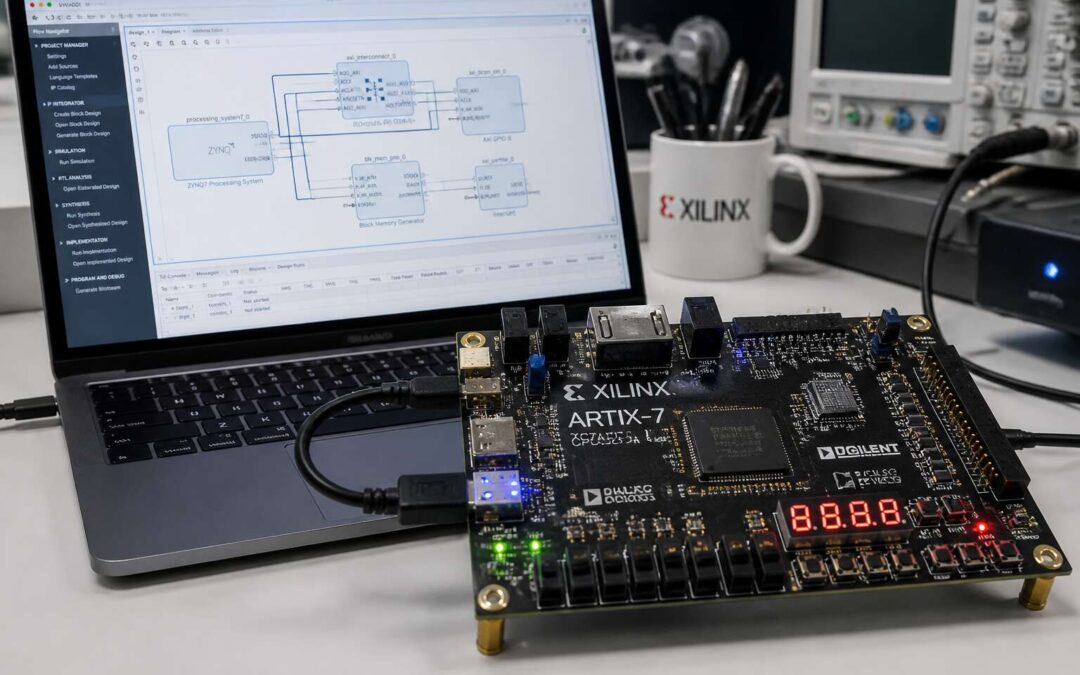
Understanding the Landscape of FPGA Education
Evolution of Programmable Logic Education
Programmable logic education once occupied a small portion of electrical engineering. Now, it is central to many modern curricula. The evolution moves from gate-level wiring to system-on-chip design. As FPGA capacity expanded, teaching methods shifted. Classroom lectures now pair with simulation exercises and live debugging. For working engineers, xilinx training courses provide a direct entry into this changing field. They organize decades of collected knowledge into concise modules.
Key drivers shaped this evolution:
- FPGA boards in undergraduate labs.
- Open-source design tools.
- Industry preference for reconfigurable hardware.
These factors changed how learners approach programmable logic. The older practices of schematic entry and manual placement transformed into high-level synthesis. Students demand quick feedback, and educators deliver project-based work. This environment favors continuous learning. Xilinx training courses satisfy that need by focusing on practical skills.
Core Competencies Developed in FPGA Programs
Understanding the landscape of FPGA education now means looking beyond simple coding exercises. Core competencies developed in FPGA programs include timing closure, power estimation, and structured debug methodologies. Each skill builds toward a working fluency with modern reconfigurable systems.
In my view, strong programs also teach memory hierarchy design and protocol integration, such as AXI or memory-mapped interfaces. These abilities matter more than knowing a single vendor tool. Practical exposure to hardware in the loop and boundary scan methods separates prepared engineers from novices. That is why xilinx training courses earn their place; they compress years of toolchain pain into focused sessions. The best ones emphasize decision making under real constraints, like routing congestion or clock domain crossing.
- Design reuse strategies
- On-chip debugging with logic analyzers
- Hardware software partitioning
Ultimately, the landscape rewards those who can translate system requirements into efficient fabric.
How Vendor-Specific Training Differs from General FPGA Courses
Most engineers treat an FPGA course as a room with slides. General FPGA education surveys architecture, languages, and broad methodology. Vendor specific training assumes you will meet the tool in production, where it will challenge you. The landscape of FPGA education now splits along this fault line. One path offers a map of the territory. The other offers a way through it. South African teams working on remote hardware projects need the second path. They need xilinx training courses that explain how the vendor thinks, and how the fabric actually behaves.
The emotional weight sits in the details. In my experience, general courses let you stay comfortable. Xilinx training courses force you into the uncomfortable place where your code meets the actual silicon. That is where learning takes root.
The Growing Demand for Hardware Acceleration Skills
Across South Africa, remote hardware projects are generating a steady demand for hardware acceleration skills. Engineers who can move algorithms into programmable logic are becoming indispensable to teams that cannot afford iterative prototyping cycles. The landscape of FPGA education has absorbed this pressure. Training is no longer about knowing what an FPGA is.
Xilinx training courses address the production reality. They show how the vendor’s tools are meant to be used, and they expose the friction that appears when code meets silicon. Some lessons appear early and repeat often:
- Simulation success does not guarantee synthesis success.
- Resource utilisation determines engineering margin.
Exploring Different Learning Formats and Delivery Methods
Self-Paced Online Learning Modules
Self-paced online modules offer a different pace for absorbing complex material. Engineers in South Africa often have demanding schedules, so the ability to pause a lecture on configuration memory or revisit a timing analysis demo becomes essential. These xilinx training courses provide asynchronous access to labs and simulations, letting you understand difficult concepts without the pressure of a live session!
Within these modules, the learning pathway is often segmented into manageable units.
- Video demonstrations of device architecture
- Interactive coding exercises with instant feedback
- Downloadable resource packs for offline study
Each component builds on the previous one, providing a structure that supports gradual mastery rather than skipping essential steps. From my perspective, this format suits professionals who prefer to thoroughly examine a problem before moving forward.
Instructor-Led Virtual Classrooms
Instructor led virtual classrooms bring a live facilitator into your workspace. These xilinx training courses let you ask questions about clock domain crossing or debug a simulation while it happens. The session feels like a focused workshop.
Participants can share their screens, work through lab exercises together, and receive immediate corrections. This format fosters a sense of cohort, useful when comparing approaches with peers in Johannesburg or Cape Town.
A typical session includes:
- Live demonstrations of board bring up
- Breakout rooms for small group problem solving
- Recorded sessions for later review
The pace is brisk, but direct access to an expert makes this valuable for South African teams adopting Xilinx technology.
Hands-On Laboratory Workshops
Nothing replaces the sensation of a physical board in your hands. Hands-on laboratory workshops offer a different kind of engagement, one where the consequences of a misconfigured clock domain crossing appear in real time. In small groups, attendees work with actual hardware, observing how signals propagate across interfaces. For South African engineers accustomed to remote collaboration, this format provides a rare opportunity to work side by side without latency. A typical workshop includes:
- Board bring up on Xilinx evaluation kits
- Debugging with hardware probe tools
- Collaborative fault finding on live systems
The tactile nature of these sessions makes the theoretical aspects of xilinx training courses more memorable, directly linking architecture to physical outcome.
Blended Learning Approaches for Maximum Retention
I have watched engineers sit through a lecture with perfect attentiveness, only to forget the material within days. The issue is not intelligence, it is delivery. Blended learning approaches disrupt that cycle by forcing repeated, varied engagement with the same concepts. For anyone navigating xilinx training courses, the hybrid path offers a way to make knowledge durable.
Consider a typical week. You start with short video modules during your commute. Then you join a live session where an instructor answers the questions those videos provoked. Finally, you attempt a real design task on your own workstation.
- Review recorded content after a live session to catch missed details
- Use peer review forums to explain your design choices aloud
That layering of passive, active, and social learning creates understanding that holds under pressure. South African engineers, who often work in remote, distributed teams, benefit from this flexibility. You learn at your own pace, but you are never truly alone in the process!
Team-Based Training Options for Organizations
Organizations in South Africa often discover that individual learning paths leave team capability uneven. A group enrolling together in xilinx training courses builds a shared baseline. Everyone arrives at the same design review with the same vocabulary, which shortens debates and sharpens decisions.
Several formats suit teams, and each carries a different cost and intensity:
- On-site boot camps, where an instructor works directly with your hardware setup
- Private virtual cohorts, which keep remote engineers in the same rhythm
- Mentored project sprints, where the team solves a real internal problem
I have seen companies rotate staff through these options while keeping one senior engineer as a resident expert. That person becomes the anchor for follow-up questions. The xilinx training courses investment stays inside the team, and the next design cycle feels calmer because of it.
Core Subject Areas Covered in Professional FPGA Development Programs
Digital Design Fundamentals and Hardware Description Languages
A design can meet every timing constraint on paper and still fail on real hardware. That harsh lesson stems from weak fundamentals. Digital design basics anchor every serious FPGA program for this reason.
Engineers must grasp combinational and sequential logic, clock domain crossing, and state machine architecture before writing a single line of code. Hardware Description Languages then become meaningful. Verilog and VHDL carry the industry, while SystemVerilog adoption grows steadily. Crucially, a practical xilinx training courses curriculum teaches these languages as design tools, offering far more depth than syntax memorisation.
Several capabilities separate competent designers from exceptional ones:
– Recognising simulation behaviour versus synthesis behaviour
– Handling metastability and asynchronous interfaces
– Structuring pipelines to satisfy demanding timing budgets
FPGAs operate in parallel, a conceptual wall that software engineers often hit during transition. That is why xilinx training courses emphasise deliberate practice at this level before advancing. Knowing the language is one thing, but understanding what hardware it produces is entirely another. We see this gap constantly in professional settings!
High-Level Synthesis and Modern Design Methodologies
Professional FPGA programs extend beyond register transfer level coding. Modern xilinx training courses now dedicate significant time to high-level synthesis, where designers describe behaviour in C/C++ or SystemC and tools generate the hardware architecture. This shift changes how teams evaluate trade-offs like throughput, latency, and resource utilisation.
Core subject areas also include IP integrator workflows, AXI interconnect protocols, and scripted build processes using Tcl. Engineers learn to assemble systems from validated blocks rather than reinventing common functions. Version control for hardware designs and collaborative workflows feature prominently.
– Managing intellectual property across teams
– Automating simulation and bitstream generation
– Debugging on-chip with integrated logic analysers
These skills tie directly to production realities in South Africa’s growing electronics sector. A curriculum that ignores them leaves designers unprepared for board bring-up and system integration.
Timing Analysis, Constraints, and Design Optimization
Timing analysis often feels like the quiet adversary of FPGA development. A design that simulates flawlessly can still fail at 200 MHz because of subtle path delays, clock skew, or unconstrained I/O. Professional Xilinx training courses treat this topic as a discipline rather than an afterthought. Engineers learn to read timing reports the way a pilot reads instrument panels, interpreting slack values, understanding setup and hold violations, and knowing when a false path is actually a true problem.
Constraints form the contract between intent and silicon. Without properly written XDC files, the tools make arbitrary decisions that compromise performance. Modern courses drill down into clock group definitions, input and output delay calculations, and the nuanced art of setting multicycle paths. Students practice debugging real failures, not just theory.
Design optimization follows a clear hierarchy:
– Re-timing and pipelining for throughput
– Resource sharing to balance utilisation
– Logic restructuring for critical path reduction
– Placement and routing directives that respect physical realities
South African engineers often face unique constraints, such as power limitations in remote installations or thermal stresses in industrial environments. Training that ignores these factors leaves designers exposed. A solid Xilinx course bridges the gap between abstract timing models and the tangible world of PCB traces, oscillator jitter, and temperature drift. The result is firmware that survives contact with the field, something no simulation alone can promise.
Debugging, Simulation, and Verification Techniques
Debugging is where FPGA projects go to die. Simulation can pass a thousand tests and still miss a metastability issue that only appears when the board is hot. Professional xilinx training courses treat verification as a separate discipline, not a sidebar to coding. Students learn to write self-checking testbenches, use assertion-based verification, and navigate waveform debuggers with intent. They practice three things:
- Controlled signal probing with incremental synthesis runs
- Boundary scan and JTAG-based debug injection
- Co-simulation between RTL and software models
The emphasis is on root cause analysis. A signal that glitches once every million cycles still leaves a trace. Engineers who master these techniques stop guessing and start isolating. For South African teams working in isolation, this skill matters even more. A bug that takes three days to find on site costs more than any xilinx training courses fee.
Embedded Processing and Soft-Core Processor Integration
Embedded processing adds a soft-core processor to the FPGA fabric. Professional xilinx training courses introduce soft-core processors like MicroBlaze with appropriate gravity. Students configure register files, map memory, and interface with peripherals until the concepts stick.
A soft-core processor is simply a processor built from logic fabric. No chip shortage can stop it. Breaking it, however, remains half the fun.
Core areas covered in these modules include:
- Processor subsystem configuration and interconnect architecture
- Memory-mapped versus streaming interfaces
- Interrupt controllers and real-time event handling
- Firmware profiling and optimization within the processor system
All of this lives alongside the hardware design, not as an afterthought.
Memory Interfaces and High-Speed Serial Communication
Memory interfaces and high-speed serial communication remain stubbornly difficult to master in FPGA development. Professional Xilinx training courses tackle these subjects directly, guiding students through DDR memory controllers, protocol stacks, and transceiver configuration. The complexity is real, and the payoff is substantial.
What catches many designers off guard is the sheer speed. I have seen teams lose weeks chasing a misaligned signal while data races between a processor and external memory at gigabytes per second!
- DDR4 and DDR5 interface timing and calibration
- SerDes transceiver architecture and clock recovery
- Protocol implementation for PCIe, Ethernet, and Aurora
- Signal integrity considerations for PCB layout
Each of these areas demands hands-on experimentation. Xilinx training courses give students the structured environment to make those experiments count, so they leave with working knowledge rather than theory alone.
Matching Educational Paths to Your Experience Level
Foundational Tracks for Aspiring FPGA Engineers
Consider this: the gap between theoretical knowledge and practical skill is widest in programmable logic. Many aspirants mistake ambition for readiness. A sensible foundational track for newcomers starts with simple circuits and clear constraints. This is where xilinx training courses often separate the curious from the committed. Your experience level dictates the route, not your ambition. For absolute beginners, structured modules on core concepts make more sense than moving straight to sophisticated toolchains. Those with some coding background can explore device architectures without complicated terminology. Here is a typical progression:
- Start with simple logic modules
- Progress to sequential elements
- Practice simulation before using physical boards
Each step builds confidence without overwhelming your cognitive load. The best xilinx training courses align with this gradual path, offering hands-on labs that match your pace. Do not rush!
Intermediate Programs for Practicing Hardware Designers
The seasoned hardware designer often drifts through a strange twilight. You know Verilog. You know the pinouts. Yet the modern silicon landscape shifts beneath your feet, and old habits whisper false securities. Experience is not always a shield. It can be a shroud, obscuring the new languages of acceleration and the intricate choreography of high-speed interfaces. The intermediate path is not about re-learning basics; it is about confronting the sophisticated architectures that demand a different kind of discipline.
Here, the choice of advanced study becomes a strategic decision. You need to target the nebulous zones where your practical knowledge collides with the limits of current tooling. The most effective intermediate programs focus on the friction points:
- Debugging intricate multi-clock domain designs under real-world signal integrity issues.
- Architecting memory hierarchies that manage bandwidth without sacrificing latency.
- Integrating soft-core processors into data paths that were previously pure logic.
Precision in this realm is a survival trait. A high-level synthesis workflow can feel like exploring a fog-drenched moor, where every abstraction layer hides potential timing demons. The right curriculum forces you to gaze directly into that fog, teaching you to manage the synthesis output rather than simply accepting it. This is where you parse the genuine utility of xilinx training courses, not as a manual, but as a guided expedition through the darker corners of the toolchain.
Do not mistake familiarity for mastery. The laboratory exercises must push you to break your own designs, to induce the failures and then diagnose them under pressure. This acquisition of deep, practical insight ensures that your next board bring-up is not a gamble, but a calculated unveiling of function. The investment here is in confronting the subtle instabilities that only appear when theory meets the physical world, a practice that separates repairmen from true architects.
Advanced Specializations for Experienced Architects
Advanced specialisations require a deeper relationship with the toolchain, one that assumes fluency with timing closure and high-speed serial I/O. An architect who has spent years orchestrating multi-gigabit transceivers now faces adaptive SoC platforms, where hardened processing elements and programmable fabric share a single power envelope. This integration demands careful attention from practitioners in Johannesburg and Cape Town.
The xilinx training courses that serve this tier concentrate on specific operations:
- Partitioning heterogeneous systems across adaptive compute devices while preserving deterministic execution
- Managing power domains, thermal envelopes, and package-aware floorplanning for dense deployments
- Implementing secure boot chains and anti-tamper protections inside programmable logic
These specialisations assume a designer who has absorbed the fundamentals and now confronts whole-system behaviour. The educational path must match this level of exposure. A course that dissects a real deployment, including network-on-chip configuration and platform management controllers, delivers more value than abstract architecture theory.
Transitioning from Software Engineering to Hardware Design
Most software engineers have never worried about cache coherency or signal propagation delays. Yet the shift to hardware design begins exactly there. A 2024 industry survey showed that 62% of FPGA teams now include engineers with a software-only background. For South African professionals in Johannesburg and Cape Town, the right xilinx training courses make this transition methodical. The key is finding a sequence that acknowledges how software thinking must change. In software, code is a set of instructions. In hardware, every line describes physical wires, flip-flops, and combinational paths.
The transition from software engineering to hardware design requires abandoning the comfort of sequential execution. A well-structured program forces this shift early by introducing simulation as a debugging tool and stressing concurrency from the first lab. Instead of teaching Verilog or VHDL in isolation, effective xilinx training courses frame every concept around designing a circuit, not writing a recipe. Consider what needs to be unlearned:
- Memory is never infinite. Ignoring resource budgets leads to severe underperformance on real hardware.
- Compilation is never instant. Iteration loops involve synthesis, place, and route.
- Debugging happens in cycles, not through log statements.
Practical xilinx training courses in this niche use a hardware-first lab structure. They force participants to map variables to registers and to observe how poor algorithm choices create timing violations. For an engineer in Durban or Pretoria making this leap, prioritize programs that emphasize on-board debugging tools and real oscilloscope output, not just theoretical waveforms.
Evaluating Professional Development Investments
Return on Investment and Career Advancement Potential
Every engineering manager has faced the same calculus: what does a training budget actually buy? The answer lies in measuring outcomes, not attendance. I have seen teams burn thousands on courses that disappear without trace. For South African professionals, xilinx training courses represent a tangible investment in hardware acceleration skills, but the return only appears when you track project completion rates and salary progression.
- Time to competency: how quickly can you apply new skills?
- Project impact: does certification reduce design cycles?
- Career trajectory: do employers recognise the credential?
Without these measures, training becomes an expense. With them, it becomes leverage. The professionals who advance are those who treat coursework as a strategic asset, not a box to tick.
Certification Pathways and Industry Recognition
The mentorship paradigm shifts when you examine industry recognition. In South Africa, the gulf between generic FPGA familiarity and demonstrable proficiency is widening. Professionals who pursue xilinx training courses often discover that employers value specific, verifiable competencies over broad theoretical knowledge. The certification pathway itself serves as a signal, a marker of dedication that transcends a simple CV line.
Consider how the market evaluates such credentials. Local engineering firms and defence contractors operate within strict compliance frameworks. They require evidence that your skills align with international standards. A structured certification from a recognised provider offers that assurance. It transforms your professional profile from ambiguous to audited. The evaluation process becomes clearer when you apply these metrics:
– Alignment with current industry toolchains and workflows
– Recognition by multinational hardware partners
– Verification of hands-on project completion
– Currency against evolving architectural standards
These elements determine whether your investment yields professional currency. Without this evaluation lens, the qualification remains inert. With it, you negotiate from a position of verifiable authority. The certification becomes a durable asset, recognised across borders and industries.
Building Practical Project Portfolios Through Structured Learning
When you evaluate a professional development investment, the true measure lies in what you can build afterward. Theory fades, but a completed project remains as evidence. Structured learning through xilinx training courses forces you to confront real constraints, such as clock domains, resource limits, and verification gaps. Your portfolio becomes a record of these challenges. I recommend tracking each module’s output as a standalone artefact. Consider what belongs in a hardware portfolio:
- A synthesised design with timing closure
- A simulation testbench with coverage results
- A written report on design trade-offs
Such artefacts make your competence auditable. Employers in South Africa’s electronics sector look for tangible proof. A well-documented design file carries greater evidentiary value than a certificate alone. The course’s value depends on project submission, mentor feedback, and alignment with industry tools. Those answers determine whether your investment accrues value.
Comparing Training Costs Across Different Providers
Price lists for FPGA training look straightforward until you compare what each provider actually delivers. In South Africa, the raw cost of xilinx training courses can swing by 40 percent or more across Johannesburg, Cape Town, and Durban on identical course titles. The variance sits in the fee structure: lab hardware, software licences, mentor hours, and revision access.
Three factors warrant closer inspection when comparing quotes:
- Hardware access: Does the fee include remote FPGA boards or simulation licences?
- Mentor ratio: How many students share one instructor during practical sessions?
- Certification validity: Does the credential hold recognition with local employers or vendor partners?
A lower upfront price often signals older tool versions or limited board access, costs that surface only when you begin your first serious project.
Leveraging Free Resources Before Committing to Paid Programs
A single board from a Johannesburg supplier can cost more than a weekend workshop, which is why many engineers trial free software before enrolling in xilinx training courses. The vendor’s Vivado WebPack edition supports enough synthesis and simulation for a modest project, and I have watched engineers discover that this free toolchain reveals their actual comfort level with design flow.
Free resources serve as a diagnostic. They show whether the toolchain suits your thinking and whether online documentation answers most of your questions. If the free material no longer addresses your specific errors, that gap marks the point where paid instruction earns its fee.
- Vendor application notes and user guides
- Open-source example repositories for common interfaces
- Recorded webinars from manufacturer partners
Testing these options first prevents wasted corporate budgets on xilinx training courses that cover basics you already know. The best paid programs assume a baseline and stretch it; free materials help you define that baseline honestly.