
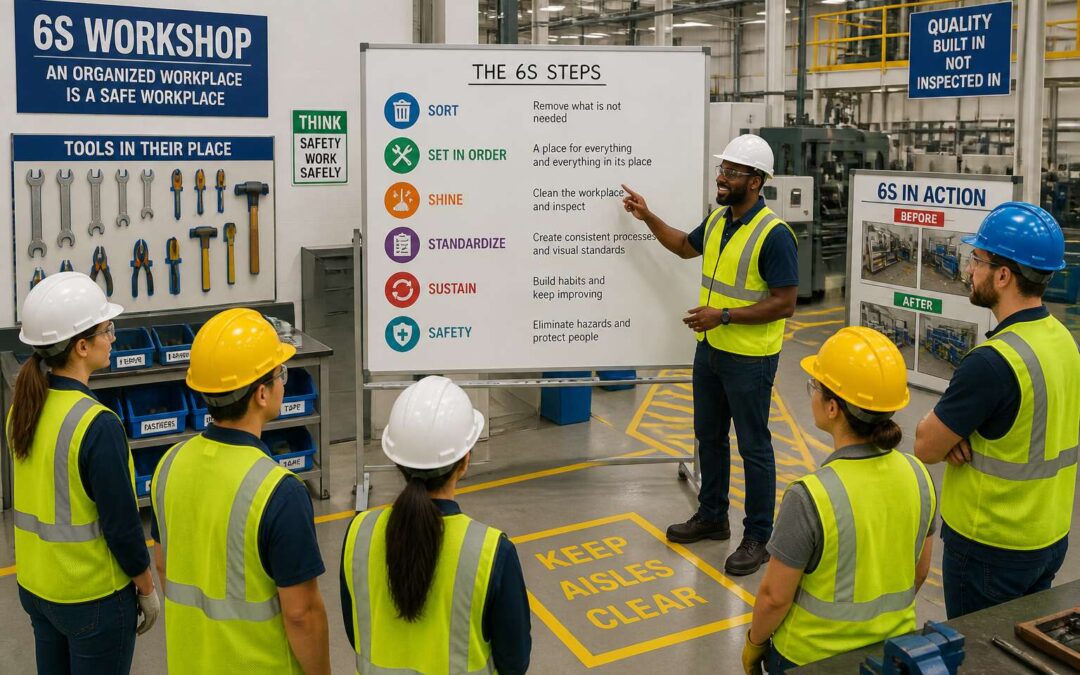
Understanding the 6S Framework
The Origins of Lean Workplace Organization
In the 1950s, Toyota’s factory floors were chaotic. Parts sat in haphazard piles, workers lost minutes hunting for spanners, and quality suffered. Engineers devised a workplace organisation method built on five Japanese words. Western manufacturers later added Safety, creating the 6S framework.
Understanding the 6S framework means recognising that each step builds on the one before it. Sort removes the clutter. Set in Order assigns a place for everything. Shine keeps the area spotless. Standardise documents the process. Sustain makes it a daily habit. Safety protects your people. This sequence, from Sort through Safety, forms the core of what 6s training courses teach.
Modern 6s training courses translate these principles into practical routines for South African operations spanning food plants, warehouses, and machine shops. The origins of lean workplace organisation matter because they reveal a system that never relied on expensive technology. It relied on disciplined processes.
Breaking Down the Six Pillars: Sort, Set in Order, Shine, Standardize, Sustain, Safety
Sort asks what you need within reach today. Anything without a clear purpose in the next thirty days gets relocated. Set in Order assigns a logical home for each remaining item, using floor markings or shadow boards. Shine turns cleanliness into an inspection tool, exposing leaks, wear, and drift before they become failures. Standardise locks these habits into written work instructions. Sustain builds the self-discipline to repeat them without supervision. Safety threads through every step, removing hazards and ergonomic risks. This sequence gives 6s training courses their practical rhythm.
In practice, the pillars answer a sequence of questions:
- Which items are essential?
- Where should each essential live?
- How clean does a surface need to be to reveal defects?
- What written rules make this repeatable?
- How do we prevent backsliding?
- Who could get hurt, and how?
That is why 6s training courses emphasize practical application over abstract theory.
How 6S Differs from 5S and 7S Methodologies
Let’s be honest: 6S is not simply 5S with a safety checkbox. It is a structural upgrade. The sixth pillar, Safety, forces every other step to answer a different question. Sort now asks whether an item is safe to keep. Set in Order asks whether storage causes strain. This shift matters for South African warehouses, where compliance audits favor teams that can show proactive risk removal.
7S takes a different direction. It usually adds “Spirit” or “Skills” to the mix, which can feel more like a morale initiative than a workplace discipline. Compare that to 6s training courses, where every pillar has a physical outcome.
- 5S: organization only
- 6S: organization plus safety compliance
- 7S: organization plus safety plus culture
If you want a system that improves handover consistency and reduces incident reports, 6s training courses deliver precisely that. They do not chase ambiguity. They chase repeatable behavior.
Core Components of Effective 6S Training Programs
Structured Curriculum Design for Adult Learners
Consider the adult learner signing up for 6s training courses. They arrive with years of workplace experience, and they need a curriculum that respects that. A structured design for adult learners starts with clear, modular outcomes. Each session builds on the last, but allows time for reflection. Learners must connect new sorting or standardizing methods to their own daily routines. If a module feels theoretical, it loses them. If it feels like a lecture, it fails.
Effective 6s training courses use problem-based scenarios drawn from real factory floors, warehouses, or offices in South Africa. In my experience, short, focused lessons work better than long presentations. The curriculum should include:
- Immediate application exercises after each concept
- Peer discussion groups that allow workers to share practical challenges
- Visual job aids that learners can take back to their workstations
This structure ties training to daily reality. The result is a lasting change in how teams approach organization.
Hands-On Application and Gemba Walks
Fewer things undermine workplace improvement more than a training room that feels removed from the grit of the operation. The best 6s training courses acknowledge this tension by making the physical workspace the primary classroom. Theory has its place, but the real transformation happens when learners stand before a cluttered workstation, a disorganized storage rack, or a poorly marked walkway. They must handle the sorting, the labeling, and the cleaning themselves. Tactile engagement beats passive listening; it creates muscle memory for order and discipline. For a South African factory floor or a busy logistics hub in Johannesburg, this is about applying standards where the dust and the deadlines actually live.
Here is where the Gemba walk becomes an irreplaceable tool. Facilitators guide small groups to the actual work area, not to offer advice, but to observe the flow of materials and the movement of people. The instruction shifts to a question: “What creates friction here?” The learner, not the trainer, identifies the redundant steps and the missing visual cues. This method cultivates ownership. It transforms abstract principles like “shining” or “standardizing” from philosophical concepts into daily habits. The most effective 6s training courses thrive on this dialogue between the facilitator and the team member. They don’t simply certify attendance; they change the perception of the workspace itself. This is the difference between hearing about lean practices and experiencing the quiet satisfaction of a controlled environment. The training succeeds when a machine operator feels confident to stop and reroute a process that threatens the standard. Nothing else matters if the training remains frozen in a binder.
Assessment, Certification, and Continuous Improvement Metrics
Assessment begins where the work happens. A written exam confirms recall, but it cannot confirm whether a sorting standard survives the next shift. 6s training courses measure progress through observable change: a labelled rack, a clear walkway, a checklist used without a reminder. Certification signals acceptance of responsibility rather than completion.
Continuous improvement metrics keep the system honest. Track:
- time lost to searching for tools
- frequency of safety incidents
- deviations caught during routine inspection
Each data point feeds the next training cycle. The most durable programs close the loop between measurement and action.
In a South African operation, these numbers expose where training actually failed. A workforce that corrects itself is the quiet proof that the program holds.
Customizing Training for Manufacturing, Healthcare, and Office Environments
Core components anchor 6s training courses in daily routine. Visual management systems, standard work instructions, and team huddles form the framework. Each component must survive a shift change.
Customization changes the execution. Manufacturing floors adopt shadow boards and machine cleaning schedules. Healthcare settings adapt sorting for sterile supplies and patient safety zones. Office environments address digital archives, cable management, and shared storage.
Select metrics by sector:
- Cycle time on production lines
- Equipment retrieval time in clinical areas
- Document access time in administrative work
Relevant examples make the training hold. Generic lessons disappear when real work starts.
Selecting the Right Training Delivery Method
Instructor-Led Classroom Sessions vs. Virtual Workshops
In a 2023 industry survey, 68% of South African manufacturers reported that hands-on practice improved recall of lean principles. Choosing between instructor-led classrooms and virtual workshops for 6s training courses requires balancing physical presence with digital flexibility.
Classroom sessions offer immediate feedback and tactile demonstrations of Sort and Set in Order. Virtual workshops reach multiple sites, yet they demand disciplined screen focus. I have seen both succeed, but the deciding factor often lies in your workplace’s rhythm.
Consider these points when selecting your delivery method for 6s training courses:
- Number of participants per site
- Access to reliable internet and devices
- Need for live Gemba walk integration
- Budget for travel and venue hire
Some organisations blend both, using virtual previews before classroom deep dives. That hybrid approach can balance cost with practical skill building.
On-Site Coaching and Facilitated Implementation
Training rooms create understanding. Factories, clinics, and offices create habits. On-site coaching bridges that gap. In my experience, workers remember a coaching session at their own workstation longer than any slide deck. The coach sees the physical constraints and the team’s rhythm, then adjusts the 6s training courses to fit that reality.
Facilitated implementation goes a step further. The coach also supports the team through the first uncomfortable weeks of maintaining new standards.
To get value from on-site facilitation, prepare these elements:
- A clear zone or line where the coach can work without disrupting production
- Scheduled time for team huddles before and after each coaching round
- A simple method to track visible changes and unresolved barriers
That structure turns advice into accountable action.
Blended Learning Models with Digital Tools and Simulations
Selecting the right delivery method starts with acknowledging that no single format works for every shift. Blended learning models pair short digital modules with structured practice time. Workers in South African plants often respond well to simulations that mirror their own production lines. A digital simulation lets them test decisions without stopping real machinery, which builds confidence cheaply.
Consider the mix carefully. In my experience, some teams need more virtual repetition before touching equipment. Others need immediate kinesthetic application. The balance matters more than the platform.
A practical selection framework includes:
- Audit current digital literacy levels before choosing tools
- Map each 6S pillar to the appropriate simulation or module
- Pilot the blend on one shift, then adjust before full rollout
When the blend respects daily pressures, 6s training courses become part of the workflow instead of another interruption.
Cost Considerations and Return on Investment
Every rand spent on 6s training courses must survive scrutiny from finance. The real costs often hide in lost production time, travel for off site sessions, and the effort of backfilling shifts. These numbers deserve honest calculation before signing anything.
Return on investment appears once teams apply the standards. Reduced scrap, quicker changeovers, and fewer safety incidents create measurable savings. One plant I worked with recovered the full course cost within four months, purely through lower tool replacement spend.
When comparing providers, consider:
- What follow up coaching is included
- Whether materials suit your local context
- How progress gets measured after the course
Choose a delivery method that shows clear returns, not a certificate alone.
Implementing 6S Training Across Your Organization
Building Internal Champions and Leadership Buy-In
Factory floors in Johannesburg and Cape Town tell a similar story about 6s training courses. These courses succeed when the people who live with the process every day become its loudest advocates. A manager can mandate order, but only a champion can make it stick. Champions typically fulfil three roles:
- They model correct behaviour during shift changes.
- They coach newcomers on sorting and standardising.
- They relay ground-level feedback to leadership.
Leadership buy-in works differently. It requires a visible presence, not a memo. When executives join gemba walks and ask pointed questions about safety or workflow, they demonstrate that 6S is measured in performance, not posters. This dual structure turns training into a self sustaining culture, and repeating the process through refresher sessions keeps the 6s training courses effective.
Phased Rollout Strategies for Teams and Facilities
Rolling out 6s training courses across multiple South African facilities often fails when companies treat every site like a carbon copy. A phased rollout respects local realities while keeping standards aligned. Starting with a single pilot line lets you test workflow solutions before committing resources elsewhere.
The rollout plan should follow a logical sequence:
1. Identify one high impact area with visible inefficiency.
2. Train a mixed group of operators and supervisors together.
3. Run the pilot for at least two full production cycles.
4. Review results against baseline metrics before expansion.
5. Scale to adjacent departments with lessons learned from the pilot.
This approach avoids the chaos of simultaneous implementation. Teams in Durban or Pretoria can adapt the sequence to their own constraints. When each phase produces measurable wins, the next group of workers sees evidence rather than promises. The language of 6s training courses becomes part of daily work life, not something reserved for scheduled sessions. That is how a structured rollout turns into sustained workplace discipline.
Overcoming Common Resistance and Sustainability Challenges
Resistance rarely announces itself. It shows up as the operator who ‘forgets’ the new standard or the supervisor who quietly reverts to old routines. In my work with South African factories, the breakthrough comes when training stops feeling like an order. When workers co-create the labels and workflows, ownership replaces reluctance!
Sustainability fails when follow-up fades. Maintenance of 6s training courses depends on routine audits that feel like support, not surveillance. One plant in Johannesburg avoided collapse by scheduling weekly 15 minute check-ins with mixed teams.
Common sustainability threats:
– Rotating staff without re-training
– Celebrating success once, then moving on
– Letting safety become an afterthought
The language of 6s training courses must change as the workplace changes. Otherwise, discipline fades quietly.
Measuring Long-Term Performance and Cultural Change
Implementing 6s training courses across an organization is less about replication, more about translation. Each department interprets the standards differently, and that is correct. The warehouse disassembles the methodology while the admin office adapts it to digital workflows. What remains constant is the rhythm of scrutiny.
Measuring long-term performance means asking uncomfortable questions. Are the metrics improving because of the system, or despite it? Plants in Durban show how scorecards can climb while culture stagnates. Cultural change reveals itself in small moments:
– An operator corrects a manager’s unsafe shortcut.
– Teams argue about standards, then find common ground.
– Cross-functional members finish each other’s sentences during audits.
These signals matter more than compliance rates. When they appear, 6s training courses have moved from initiative to identity. The organization that sustains this work stops treating certification as the finish line and treats it as the baseline. The distinction determines whether the change holds or quietly erodes.
Maximizing Value from Your 6S Education Investment
Aligning Training Outcomes with Business KPIs
Too many organisations measure the success of 6s training courses by certificates handed out or hours logged. That misses the point entirely. Value only appears when what happens on the shop floor changes, and that requires a deliberate connection between training content and the business metrics your leadership already reviews.
Consider the KPIs you track each month:
- Throughput per shift
- Rework costs
- Equipment downtime
- Safety incident frequency
If the course does not move at least one of these numbers, the investment is merely a cost.
When this alignment is built into the programme design, each module is tied to a specific KPI. Assessment then looks at observable changes in work areas rather than test scores. Training outcomes and business KPIs become directly linked, and the training stops being an event and becomes a performance mechanism.
Creating a Continuous Learning Ecosystem
A training budget evaporates quickly when the classroom becomes a one-time event. I’ve watched organisations spend heavily on 6s training courses, then return to old habits within weeks. The missing piece is a continuous learning ecosystem, where standard work, feedback loops, and small group discussions reinforce the discipline daily. The course becomes a starting point, not a single moment of instruction.
This means scheduling regular follow-ups, pairing learners with experienced coaches, and reviewing the actual work areas during team meetings. A simple list of reminders can keep the momentum alive:
- weekly area audits by shift leaders
- short refresher sessions before production peaks
- visible tracking of improvement suggestions
When these habits become routine, the 6s training courses deliver sustained behaviour change rather than a temporary spike in awareness.
Leveraging Certification for Career Advancement
The certificate hangs on the wall, but does it hang in the mind? In South Africa, 6s training courses often get treated as a human resources checkbox. That undervalues the credential. A certified employee who can articulate how Sort and Standardize reduce downtime becomes a candidate for team lead roles, not just a cleaner of shelves.
Certification from 6s training courses carries weight when paired with proof. Interviewers in Gqeberha or Cape Town ask for examples, not jargon. The assessor’s feedback becomes your evidence. Your ability to explain the shift from “we tidy on Fridays” to “we audit every Tuesday” shows operational maturity.
Leverage the certification with deliberate intention:
- Every project becomes a tracked case study.
- Outcomes appear in numbers: metres saved, minutes reduced.
- Performance reviews mention the certification.
That record transforms a piece of paper into a career lever.
Avoiding Pitfalls in Training Vendor Selection
Selecting a provider for 6s training courses requires scrutiny beyond the brochure. Many vendors in South Africa offer generic slide decks divorced from your operational reality. Ask pointed questions about facilitator experience in your sector. Request references from companies in Gqeberha or Durban that have completed the programme. Inspect their materials for local case studies.
A poor vendor leaves your team with theory and no implementation path. The right one brings assessment tools, follow-up visits, and measurable benchmarks. Verify whether the provider offers post-course support or simply hands over certificates.
Warning signs appear early in the sales conversation:
- The promise of generic certification without site visits
- The absence of post-training measurement tools
- The reluctance to share previous client outcomes
The cheapest quote often hides hidden costs in re-training and lost momentum. Your investment in 6s training courses should yield sustained behaviour change, not a one-off event.
Future Trends in Lean Training and Workforce Development
Integration with Digital Transformation and Industry 4.0
In South Africa’s manufacturing corridors, the fourth industrial revolution is forcing a reimagining of lean instruction. Static charts and printed checklists are giving way to live feedback loops. Future 6s training courses will embed digital twins and augmented reality into the Sort and Shine phases, allowing learners to experiment without shutting down production lines. The workforce of tomorrow needs to interpret machine data alongside physical cues. Smart sensors can flag a disorganised shadow board, but only a trained eye can understand why the pattern matters. Digital transformation also changes assessment. Instead of a single exam, learners accumulate evidence through day-to-day interactions with connected equipment. This creates a continuous record of competence. For companies adopting Industry 4.0, the lean journey becomes a data journey. 6s training courses now include modules on data integrity, cybersecurity, and human-machine collaboration. In practice, this re-skilling means:
- Sorting algorithms that mirror physical sorting
- Virtual gemba walks using 360-degree cameras
- Real-time visual management dashboards
Technology shifts, but the discipline holds.
Microlearning and Just-in-Time Training Modules
The days of cramming twelve modules into one week are fading. Workforce development now favours shorter, sharper interventions. Microlearning breaks 6s training courses into five minute bursts that fit between shifts. Workers in Gauteng can refresh Sort procedures on a phone while waiting for a briefing.
Just-in-time training modules deliver exactly what the operator needs, when the process demands it. No more hunting through manuals for a single step. The system embeds a prompt at the point of use. This approach reduces downtime and keeps momentum. Future trends in lean training point to bite sized video refreshers and peer coaching prompts triggered by real time workflow data.
These modules also change how supervisors track progress. They see which skills employees apply immediately after learning. The warehouse becomes a classroom. A faster classroom.
The Role of Coaching and Mentoring in Sustaining Lean Culture
South African operations lose millions in hidden waste when lean culture fades after the trainers leave. The future of 6s training courses depends less on new content and more on the steady rhythm of coaching and mentoring that carries skills from the classroom into daily motion.
Workplace learning is shifting toward distributed mentorship, where experienced operators own the responsibility of reinforcing standards. The mentor who spots a missed Shine step and corrects it within minutes builds a culture that no annual workshop can match. A mentor also:
- Models the mindset that sustains Sort and Standardize
- Shows newcomers how habits survive production pressure
This matters across sectors, from automotive plants in Uitenhage to distribution centres in Cape Town. Workers answer to people, not policies. Forward thinking organisations pair each new hire with a certified internal coach. That coach observes, guides, and challenges. Over time, coaching transforms 6s training courses from a one time event into a durable operational habit.