Foundations of Solar Installation Training
Overview of solar industry roles and job opportunities
Across South Africa, solar adoption surged 18% last year, turning rooftops into launchpads for skilled technicians. Foundations of Solar Installation Training reveals how safety, precision, and problem-solving intertwine to power reliable systems and confident teams.
Understanding the ecosystem helps you picture the work ahead. The field spans assessment, design, installation, and ongoing maintenance. Key roles include:
- System designer and energy consultant
- On-site installation technician
- Quality assurance and commissioning engineer
This work threads technical craft with social impact—each install is a quiet act of community resilience and a statement about sustainable futures.
For job seekers, training courses for solar panel installation open doors to diverse workplaces—from residential rooftops to commercial campuses—and even rural microgrids that keep communities lights-on after sunset.
Safety standards and codes essential for installers
Safety isn’t a checkbox—it’s the wind in the sails of every SA solar project. In South Africa, teams aligned with rigorous safety standards report up to 30% fewer on-site incidents. Through training courses for solar panel installation, safety becomes second nature, guiding every step from risk assessment to the moment of connection on the roof. Codes act as a compass, turning potential hazards into predictable, controlled work.
Here are core safety standards and codes essential for installers:
- SANS 10142-1 Electrical installations in buildings (latest edition)
- IEC 62446 PV systems—Safety, performance, and reliability
- OHSA and Electrical Installation Regulations (EIR) compliance
- Fall protection, ladder safety, and lockout-tagout (LOTO) procedures
- Commissioning and fault-finding protocols that verify safe operation
These guidelines shape the curriculum and hands-on practice in solar training programs, ensuring installations endure across South Africa’s varied climates and communities.
Tools, equipment, and PPE for solar projects
South African rooftops carry a quiet tension—the risk of a slip or a spark. When teams pair robust PPE with a disciplined tool kit, on-site incidents can drop by up to 40% in the early weeks. These foundations fuel the training courses for solar panel installation, turning risk into reflex.
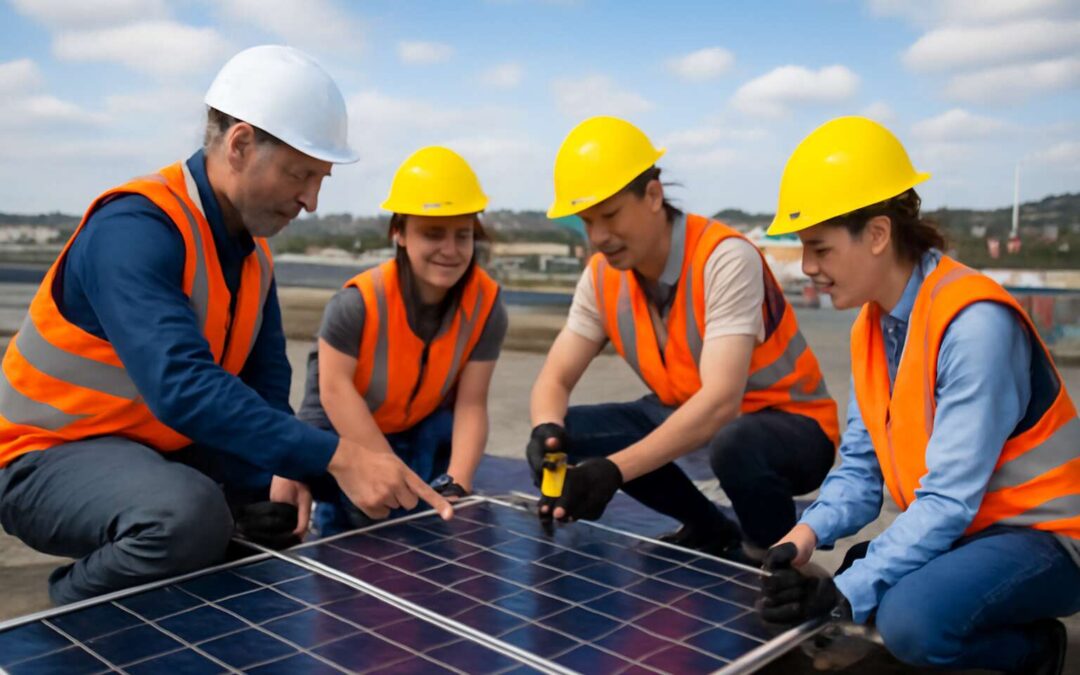
Inside core modules, trainees encounter PPE for real-world climbs: fall protection, ladder safety, and lockout-tagout. Dielectric gloves, safety glasses, and arc-rated clothing guard hands when live work looms. A lean kit of insulated tools and calibrated meters keeps voltage in check, while SA climates sharpen resilience.
Practical toolkit includes:
- Fall protection gear (harness, lanyards, anchor points)
- Dielectric PPE (gloves, boots, clothing)
- Insulated hand tools and voltage testers (multimeter, PV tester)
- MC4 crimping tool, cable cutters, torque wrench
- IR thermal camera for module checks
Fundamentals of photovoltaic systems and energy flow
On South Africa’s rooftops, resilience is built in the quiet arithmetic between sun and switchgear. In field deployments, teams rooted in solid foundations report up to a 40% drop in on-site hiccups in the first weeks. Foundations of Solar Installation Training anchor learning in the Fundamentals of photovoltaic systems and energy flow, tracing how sunlight becomes usable power, how circuits route energy, and where losses sneak in. These insights underpin training courses for solar panel installation.
- System boundaries and energy flow
- Core PV components and interconnections
- Basic electrical concepts and metering
To ground theory in reality, a compact foundation toolkit helps learners map the system.
That blend of rigor and reflection makes those training journeys more than a checklist; it becomes a way to read a rooftop like a living system, not a risk.
Curriculum and Course Formats
Learning paths and specialization options
In a sun-soaked South Africa, curriculum is the compass that turns theory into reliable roofs. A well-designed program blends practical drills with core concepts, guiding apprentices from first flux of curiosity to confident installation work. Within these training courses for solar panel installation, learners encounter modular blocks that respect different paces and aspirations.
Learning paths give direction:
- Residential rooftop PV installations and maintenance
- Commercial systems, including carport and ground-mounted arrays
- Battery storage integration and microgrid-ready designs
Course formats vary, embracing online theory, immersive labs, and on-site simulations. Learners choose learning paths that fit local demand—grid-tied, off-grid, or hybrid setups—and finish with a capstone project that showcases a polished installation and commissioning plan. Specialization options include design optimization, system commissioning, and quality assurance.
Theory modules and hands-on lab exercises
Rooftop solar uptake in SA grew by double digits last year, and that demand scratches at the door of every training center. Curriculum acts as the compass, turning theory into roofs you can stand on without wobble.
The curriculum blends theory modules with hands-on lab exercises, moving learners from equations to earthing and back again with confidence. In our training courses for solar panel installation, students navigate modular blocks that respect different paces while ensuring safety and reliability on every install.
Course formats vary, embracing online theory, immersive labs, and on-site simulations.
- Online theory modules with quick assessments
- Immersive labs simulating real roof conditions
- On-site simulations with supervised installations
A capstone project ties it together, showcasing a complete installation and commissioning plan.
Online, in-person, and hybrid training formats
Rooftop solar uptake in SA grew by double digits last year, turning every training center into a hive of bright ideas and sweaty enthusiasm. Curriculum acts as the compass, turning theory into roofs you can stand on without wobble.
The curriculum blends theory modules with hands-on lab exercises, moving learners from equations to earthing and back again with confidence. In training courses for solar panel installation, students navigate modular blocks that respect different paces while ensuring safety and reliability on every install.
- Online theory modules with quick assessments
- Immersive labs simulating real roof conditions
- On-site simulations with supervised installations
Course formats span online theory, immersive labs, and on-site simulations. A capstone project ties it together, showcasing a complete installation and commissioning plan suitable for SA sites, with flexible learning paths that fit busy work schedules. These training courses for solar panel installation suit online, on-site, or hybrid formats.
Self-paced versus instructor-led programs
Rooftop solar uptake in SA grew in double digits last year, and the surge demands a curriculum that can keep pace. Curriculum is the compass, turning dry theory into roofs you can stand on without wobble. The right course formats turn classroom concepts into field-ready confidence, so installers actually translate plans into clean, safe performance on every panel.
These training courses for solar panel installation mix self-paced theory with scheduled touchpoints for feedback. Self-paced modules let learners master electrical fundamentals on their own clock, while instructor-led sessions provide real-time troubleshooting and accountability.
- Structured progression with clear milestones
- Live demonstrations and guided practice
- Hybrid timelines for busy professionals
In the SA context, this blend supports diverse schedules and site realities, aligning safety, reliability, and ambition.
Certification, Accreditation, and Career Outcomes
Industry-recognized certifications for installers
South Africa’s solar boom isn’t just about panels—it’s about the people who install them. In SA, solar installs jumped 35% last year, and installers with credible credentials land jobs first. Certification is a passport, and choosing the right training courses for solar panel installation is step one to credibility.
Accreditation matters: programs endorsed by SAQA/NQF and QCTO ensure curricula align with industry safety standards and real-world work. Accredited courses translate to employer trust, clear on-site expectations, and portable credentials.
- Demonstrates competency across modules
- Offers portable, nationally recognized credentials
- Helps open doors to advanced roles
Career outcomes are robust: with solid certification and accreditation, graduates can progress from installation technician to site supervisor, project coordinator, or run a solar retrofit business.
Licensing requirements by region
Credibility travels on credentials; SA’s solar boom saw a 35% jump last year, and training courses for solar panel installation put skilled installers at the front of the line. Certification acts as a passport to opportunity.
Accreditation matters: SAQA/NQF and QCTO-endorsed programs align curricula with safety standards and real-world work. Accredited training translates to employer trust and portable credentials.
- Demonstrates competency across modules
- Offers portable, nationally recognized credentials
- Helps open doors to advanced roles
Career outcomes are robust: certified and accredited installers can move from technician to site supervisor, project coordinator, or solar retrofit entrepreneur. Licensing requirements by region vary; local authorities and permits shape each installation path.
Portfolio development with real-world projects
Certification acts as a passport to opportunity in South Africa’s solar boom, validating mastery across core modules and delivering portable, nationally recognized credentials that earn employer trust.
Accreditation matters: SAQA/NQF and QCTO-endorsed programs align curricula with safety standards and real work. Accredited training translates to confidence and portable credentials that travel with the installer.
- Portfolio-ready evidence of hands-on projects
- Documentation of site assessments and safety audits
- Performance data and commissioning records
Career outcomes are robust: certified installers can move from technician to site supervisor, project coordinator, or solar retrofit entrepreneur. A real-world portfolio—built from residential and commercial projects—demonstrates design, installation, testing, and commissioning prowess; the path remains credible via training courses for solar panel installation.
Job placement, apprenticeships, and employer partnerships
Across South Africa’s solar boom, certification acts as the passport to opportunity, a glowing seal that travels with the installer. SAQA/NQF and QCTO-aligned programs keep curricula tethered to safety and real work, transforming knowledge into portable, trusted credentials that employers seek.
Accreditation matters: programs endorsed by SAQA/NQF and QCTO ensure safety standards underpin every module. Accredited training translates to confidence on the rooftop and credibility in the market, a beacon for job seekers and employers alike.
- Apprenticeships with established solar installers
- Employer partnerships offering on-site, mentored practice
- Continuing professional development tied to real-world project cycles
Career outcomes are robust: certified installers can progress from technician to site supervisor, project coordinator, or solar retrofit entrepreneur. A real-world portfolio—built from residential and commercial projects—demonstrates design, installation, testing, and commissioning prowess; the path remains credible via training courses for solar panel installation.
Continuing education and advanced credentials
Across South Africa’s solar boom, 70% of projects now prioritise certified installers. Certification acts as a passport to opportunity, backed by SAQA/NQF and QCTO-aligned curricula that anchor safety and practical know-how. Accredited programs translate to confidence on the rooftop and market credibility.
For sustained growth, continuing education and advanced credentials matter. Training courses for solar panel installation provide ongoing specialization beyond entry-level certificates, translating into on-site mastery and leadership potential.
- Micro-credentials tied to real project cycles
- Advanced modules in testing and commissioning
- Safety leadership for field crews
With each credential, installers ascend from technician to site supervisor, project coordinator, or solar retrofit entrepreneur. The result is a durable, portable skill set that travels across South Africa’s diverse rooftops.
Choosing the Right Training Provider
Alignment with national and regional standards
“Education is the most powerful weapon you can use to change the world,” Nelson Mandela famously said, and that conviction holds especially true as South Africa charts its solar future. Selecting the right training provider for solar work isn’t a mere formality—it sets the tone for safety, workmanship, and ongoing opportunity on every rooftop.
To align with national and regional standards, seek providers whose courses map to SAQA’s National Qualifications Framework, carry SETA accreditation, and reflect PV-specific competencies. They should cover practical design, system integration, electrical safety, and local grid-interconnection codes, while keeping content current with South African standards. When you choose training courses for solar panel installation, look for programs that fuse theory with hands-on lab work and offer a credible path to recognized credentials.
Regional reach matters too—the right provider will offer accessible formats, regional facilities, and partnerships with local installers to support learners across provinces.
Instructor qualifications and classroom experience
Across South Africa, rooftop solar installations jumped about 30% last year, a stat that makes the sun look like a sparkly, ever-present employer. When choosing who teaches the next generation of solar pros, instructor qualifications and classroom experience are the real power players—they shape safety, problem-solving, and job readiness long after the lectures end.
- Credible teaching credentials and field certifications
- Solid classroom experience with real-world labs
- Proven ability to translate theory into practical installs
Look for providers that clearly spell out instructor backgrounds, hands-on lab hours, and opportunities to engage with local installers. The right fit will tie credentials to recognized pathways and keep content current with South African standards—ensuring the training courses for solar panel installation truly prepare learners for the rooftop and the grid.
Facility quality, equipment, and training labs
Rooftop solar installations jumped roughly 30% across South Africa last year, turning sun-drenched roofs into dynamic classrooms and new career horizons. The right training begins with the facility—not just the theory—because space, equipment, and training labs shape real-world readiness.
Look for a provider whose facility features up-to-date electrical labs, simulated rooftop setups, and well-maintained safety stations. A strong program blends reliable hardware, calibrated test rigs, and clear space to practice safely under supervision.
- Modern PV simulators that mimic real irradiance and voltage
- Realistic rooftop mounting bays and wiring runs
- Dedicated PPE storage and safety compliance zones
- Accessible maintenance and calibration records for equipment
When these elements align with training courses for solar panel installation, learners gain confidence in the grid and the rooftop, ready to meet South Africa’s growing solar demand with clarity and craft.
These training courses for solar panel installation anchor learning in solid facility quality.
Cost, funding options, and return on investment
Rooftop solar installations jumped 30% across South Africa last year, turning sunlit roofs into laboratories of opportunity. From the first contact, the question is not merely price but potential—ROI whispers louder than the quoted fee. Choosing the right provider for training courses for solar panel installation means weighing value, outcomes, and the quality of post-course support. From my experience, smart investment pays back quickly.
Consider these funding avenues:
- Employer sponsorship and apprenticeships
- Government or provincial training grants
- Payment plans and low-interest loans
With costs in view and credentials in hand, return on investment becomes tangible. In South Africa’s dynamic energy landscape, flexible payment options and employer partnerships can shorten the payback period. For training courses for solar panel installation, the pathway to steady employment and growing expertise is clearer than ever.